After rather a long break I have started work on all the panels that need the same treatment as the cab: blasting and priming. I have bought some more plastic and clips so that I can seal my plastic tent better to try and stop the blasting sand getting everywhere. There are a number of panels to do and I think I can complete them in two batches.
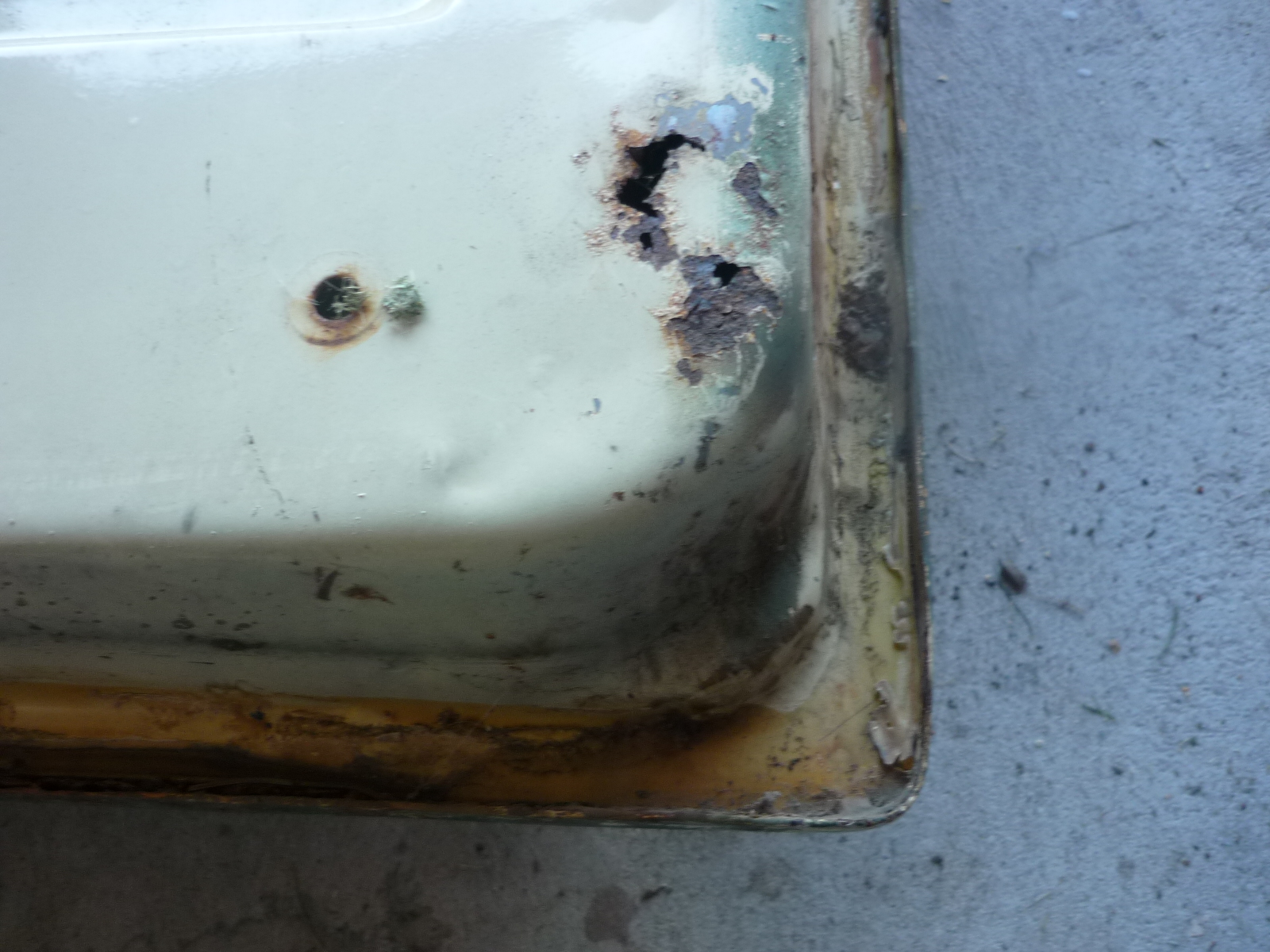
The original doors are very rusty; the mirror mounts had pushed right through the door skin so last time I was at the wreckers I bought a couple of better ones.
My understanding is that there are two styles of door. These later ones have two mirror mountings: top and bottom. The early doors had mirrors on a single arm and only one mounting.
I dismantled and photographed the doors.
They came apart quite easily and of course I will have another set of parts from the original doors. It would be nice to get new rubbers but I have not seen any for sale. I scan eBay regularly for TK parts and although there are always plenty of bits for sale the actual range of components is quite limited. Windscreen rubbers are easily available but the rest are not.
Once the blasting and priming is complete I will move on to any welding and rust repair that is needed. These were the best doors I could find but still some minor rusting on the inner skin. It will be interesting to see what they look like after blasting.
Thursday, 6 June 2013
Sunday, 21 April 2013
Cab Complete
After a bit of a gap in my blog I can now report that the blasting a priming of the cab is complete and I have moved it into another shed while I make a start on doing the same to all the other panels.
I have blasted and painted all of the cab except:
- The front panel which is quite rusty and damaged. I intend to replace it with the one from the old cab which is much better.
- Some of the interior such as the rear firewall and parcel shelf which were painted and showed no signs of corrosion. There simply didn't seem to be any point in stripping and re-painting these; they are going to have carpet glued to them anyway.
Monday, 25 March 2013
Painting the roof
Before I went for a week's holiday in sunny Hawke's Bay I blasted and painted the roof. I was pleased to find virtually no rust in the joint where it is welded to the gutter.
The gutter joint on the original cab has completely blown apart with rust and would be almost impossible to repair which was the main reason for getting the new cab. After blasting I gave the gutter a couple of thick coats of the urethane anti-rust primer before spraying with epoxy. I can report that resealing the black primer can with a layer of food wrap worked well; there was no sign of the paint setting and the lid came off easily.
I discovered that for a large area like this, my standard 1.4mm gravity gun really struggled to get enough paint on evenly. The epoxy primer is quite thick and whereas it was fine spraying a narrow pattern as soon as I opened the fan up hardly any paint came out so the end result although acceptable is a bit rough and uneven. The data sheet for the primer recommends airless spray, brush or roller above conventional spraying and this is why I guess. Next time I have some mixed up I will try thinning a little more and add another coat to see how it goes. I intend to spray the whole thing with a high build primer when I come to painting anyway; this layer is really just to seal the surface.
The gutter joint on the original cab has completely blown apart with rust and would be almost impossible to repair which was the main reason for getting the new cab. After blasting I gave the gutter a couple of thick coats of the urethane anti-rust primer before spraying with epoxy. I can report that resealing the black primer can with a layer of food wrap worked well; there was no sign of the paint setting and the lid came off easily.
I discovered that for a large area like this, my standard 1.4mm gravity gun really struggled to get enough paint on evenly. The epoxy primer is quite thick and whereas it was fine spraying a narrow pattern as soon as I opened the fan up hardly any paint came out so the end result although acceptable is a bit rough and uneven. The data sheet for the primer recommends airless spray, brush or roller above conventional spraying and this is why I guess. Next time I have some mixed up I will try thinning a little more and add another coat to see how it goes. I intend to spray the whole thing with a high build primer when I come to painting anyway; this layer is really just to seal the surface.
Monday, 4 March 2013
Tin Bashing
After blasting the roof panel clean I was pleased to find that there was no significant rust but it was much more dented than I had thought. The large dents along the back I had already popped out and I am not too worried about them anyway because the body that will go back on has a Luton so the cab roof is pretty much hidden from that angle. However, the front edge of the roof will show and had numerous dents so after a few hours at the University of YouTube I went to our local second hand shop and bought some tools.
...and set to making a lot of noise. I also used a rubber mallet with a rounded head for knocking the bigger dents roughly into shape. The best combination for this job seemed to be the red hammer which as quite a crown to its faces and the mushroom shaped dolly. The technique is to run a sanding board with 40 grit emery over the surface to reveal the high spots and low spots, then work on them with hammer and dolly, then repeat.
The panel and its dents did not photograph well but here is the end result.
...and set to making a lot of noise. I also used a rubber mallet with a rounded head for knocking the bigger dents roughly into shape. The best combination for this job seemed to be the red hammer which as quite a crown to its faces and the mushroom shaped dolly. The technique is to run a sanding board with 40 grit emery over the surface to reveal the high spots and low spots, then work on them with hammer and dolly, then repeat.
The panel and its dents did not photograph well but here is the end result.
I'm sure a real panel beater would scoff at my efforts but the result is a great improvement from where I started so I'm pleased enough. I think that a thin skim of filler will give an acceptable result.
Tuesday, 26 February 2013
Blasting kit
This is the pressure pot. It is the standard cheapo Chinese kits that all the discount tool shops seem to be selling. It is not a great tool but it is cheap and it is adequate. This is the smaller of two they had on offer and I think the right choice; it is very heavy when full and one twice the size would be difficult to manage since you have to drag it around the work area. This size give about 30 minutes blasting. The sand is poured in through the red lid on the top. Note that this is the largest opening to the vessel so you really need to be careful not to get any big lumps or foreign objects in there; it would be difficult to get them out again.
The grit destroys everything in its path including the air valves and the ceramic blasting tips. I am blasting with a C-grade garnet which is quite coarse removing paint and rust easily.
The tips wear very quickly, you would be lucky to get an hour's blasting from each. These are 3mm tips but as they wear the bore increases and pressure is lost. These are about $8 each I will have spent $100 or so in tips for the cab. The garnet is $22 for 25kg. It is largely recycled by sweeping it up and sieving it so it lasts quite a while. Blasting the cab has will probably use up 50kg.
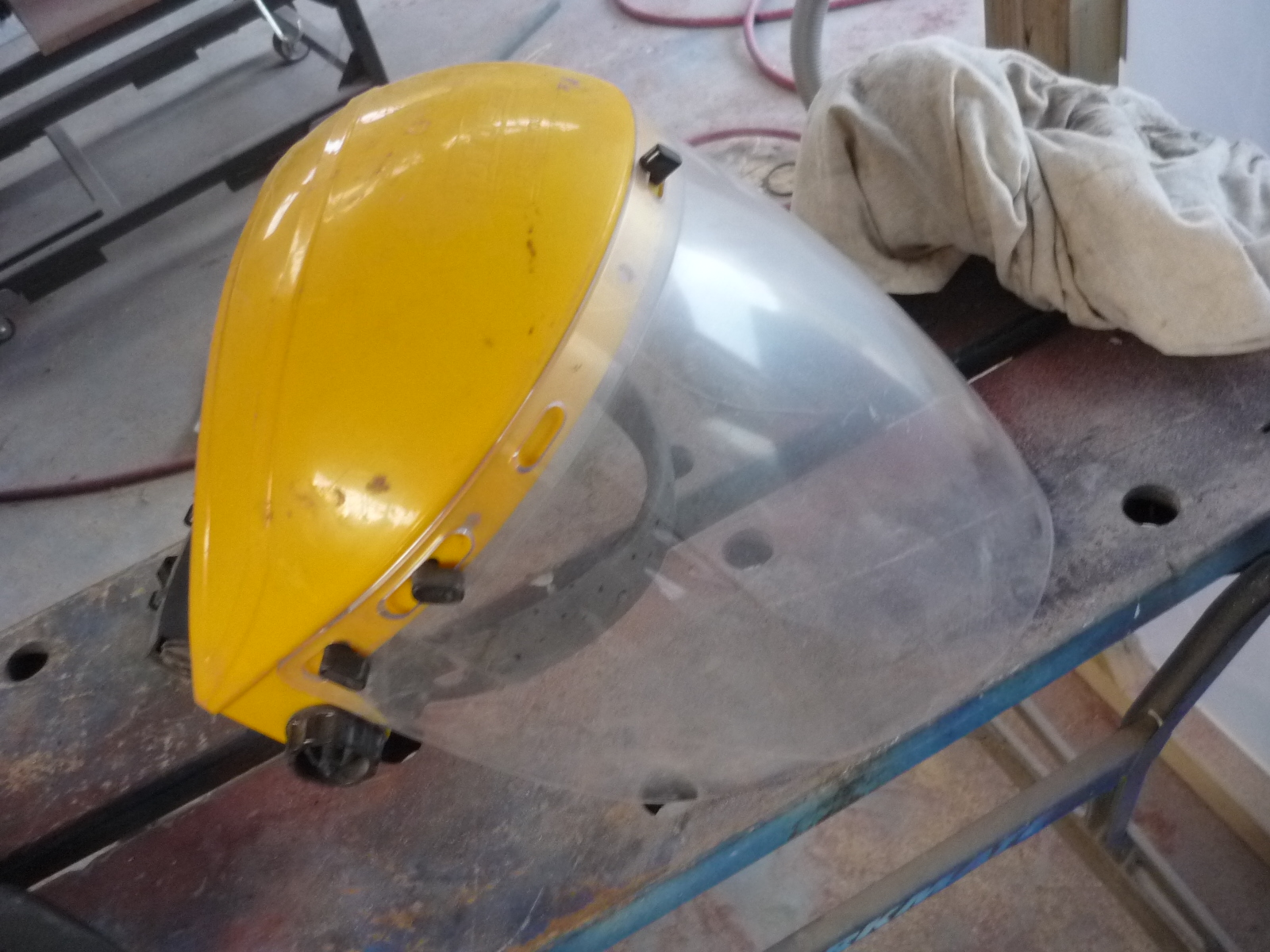
There is a sort of fabric balaclava helmet that came with the blaster and I use a dust mask and this face shield inside it. It does not work that well; the glass steams up and the sand destroys the plastic visor so that you end up working though a sort of fog.
Other kit is shown here - a dustpan for scooping the sand off the floor, an ordinary household sieve for cleaning it and a funnel with a large opening for putting it back into the pressure vessel. Front right is the dust mask which is pretty much essential through the whole process.
Compressing that much air generates a lot of water in the air lines and this in turn clogs up the sand as it flows out of the bottom of the pressure vessel which is very annoying. I'm running two water separators in the air line and they remove plenty of moisture but still not enough.
Sunday, 24 February 2013
The Rusty Floor
Since the floor was still quite pitted after blasting I gave it two coats of this stuff:
It is a moisture curing urethane. It reacts with the moisture in the atmosphere to form a very hard coating. It is a cheaper alternative to another product known as POR15 that is very popular amongst classic car restorers. The data sheet is here. You really need to read the instructions because this stuff sets like iron and if you put the lid back on the tin with paint on the lip it is sealed for good. You need disposable brushes; I picked up some from the same place that sold the paint for a few cents each. They recommend you use the whole can at once but since this was impractical I made a temporary plastic lid with a hole to keep the top of the tin clean. When finished I resealed the can with two layers of food-wrap between the lid and the can. I guess I'll find out if that has worked next time I need it!
This stuff is quite expensive at around $65 per litre so I only painted the heavily pitted areas and the seams. After two coats it looked like this:
The coating cures very hard and very shiny. It is degraded by sunlight so for areas that may be effected it can be over coated with just about any paint. This needs to be done within 4-6 hours. If you leave it longer they recommend you rough the urethane up with some 600 grit paper.
I put on two coats during the morning and then later in the afternoon sprayed it with the two pack epoxy primer that I described in a previous post (Interbond 373).
Thursday, 21 February 2013
Blasting the floor
The cab floor appeared to be the most rusty with heavy pitting but after blasting it came out surprisingly solid
Subscribe to:
Posts (Atom)